

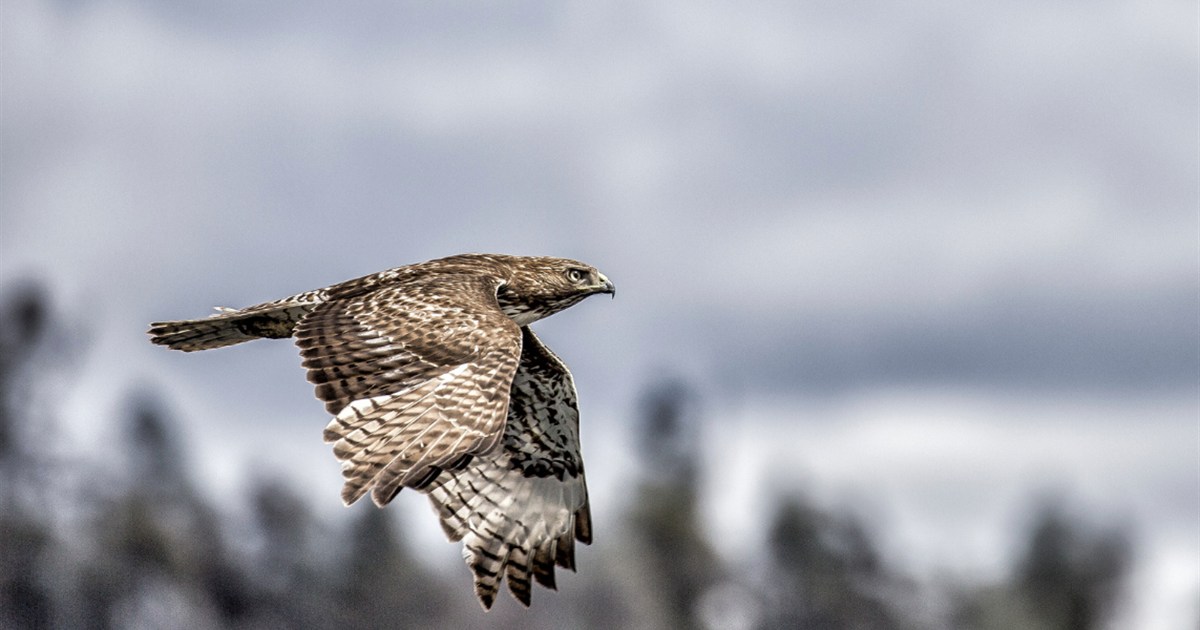
A hawk can hold your attention with a single movement: a turn in the sky, a still shape on a branch or a sudden glide across an open field. Understanding the bird can make the encounter richer, whether you approach it as wildlife watching, spiritual reflection or both.
Begin with curiosity rather than a fixed verdict. The hawk has its own life, and the meaning you find in the moment can remain a personal relationship with what you have seen.
There is more than one kind of hawk
The word hawk covers birds with different shapes, habitats and hunting styles. You do not need to identify one perfectly before appreciating it, but it helps to avoid building an interpretation on the assumption that every hawk behaves alike.
The Cornell Lab’s Red-tailed Hawk guide describes broad-winged birds often seen soaring over open areas or watching from poles. Its Cooper’s Hawk guide describes an agile hunter associated with woodland edges and other birds.
A regional guide can help you compare the species actually found where you live. A name is useful, but “a hawk I could not identify” is an honest observation too.
Watch the behavior before assigning a meaning
Notice whether the bird is perched, gliding, circling, carrying food or moving between trees. Record what is visible without assuming you know its intention. A bird remaining on a pole may be watching its surroundings rather than waiting for you to understand a message.
Use several clues for identification: body shape, wing and tail shape, markings, location and behavior. Lighting and distance can change how color looks. A blurred photograph or a brief glimpse may not be enough for certainty.
You do not need spectacular speed claims or a precise comparison with human eyesight to appreciate the hawk’s attention. The observed moment is already interesting.
Explore symbolic themes with care
If hawks suggest focus or perspective to you, ask what those qualities look like in daily life. Focus may mean choosing one task. Perspective may mean listening to someone else before settling on an explanation.
Other people may understand a hawk as a spiritual guide or associate it with a family story. Describe your interpretation in its own terms. When a teaching comes from a named tradition, learn its context rather than treating all communities as sharing one meaning.
It is also worth checking the bird named in a story or artwork. Hawks, eagles and falcons are not interchangeable labels. If you are unsure, leave the distinction open rather than using an attractive image as proof of a historical claim.
A short observation practice
- Watch from a safe distance without changing the bird’s behavior.
- Record one detail you can actually see or hear.
- Name the feeling or question the encounter brings up.
- Choose a sensible response, if one is useful, without requiring the sighting to predict anything.
For instance, a perched hawk might remind you to give a decision more attention. Your next step could be gathering information or preparing a question. The bird does not have to certify the decision for the reflection to help.
Let respect be part of the meaning
Give nests and hunting birds room. Do not bait a hawk for a photograph, attempt to handle it or take feathers and other bird materials as proof of connection. Follow local wildlife rules and seek professional help for an injured raptor.
If hawks seem to be appearing repeatedly, read seeing hawks all around you. For a broader framework, explore bird sightings and spiritual meaning or keep a nature journal.
This article provides fascinating insight into the symbolism of hawks. I appreciate the emphasis on leadership and mental intelligence.
‘Some believe that a hawk sighting can mean that you are a planner.’ Can someone point me in the direction of these ‘some’ who believe in such superstitions?
The author could have delved deeper into scientific facts about hawks before discussing their spiritual meanings.
The hawk symbolism is intriguing, but it seems like an excessive stretch to say that seeing a hawk means I should focus more. Isn’t that a bit of a cliché?
I’ve always been drawn to hawks, and this article reinforces my belief that they are messengers with a special connection to psychic gifts. Thanks for sharing!
‘If you see a hawk, you should watch them because they might have a message for you.’ What if the message is ‘I’m hungry’ or ‘Look, I can fly really fast!’? Hawks are just birds!
While I appreciate the spiritual interpretation, attributing personal attributes like smartness and caution to seeing a hawk seems unfounded. It’s likely just a bird flying by.