

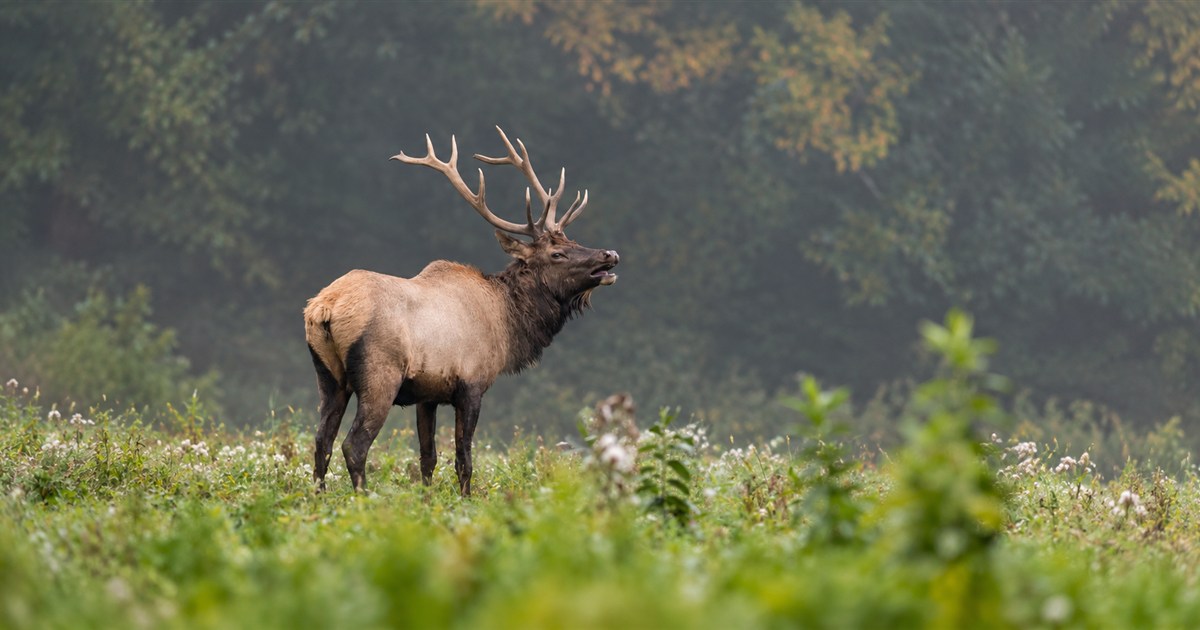
An elk’s size, antlers or carrying call can leave a strong impression. If you feel a spiritual connection with the animal, strength and endurance may be the first themes that arise. There is room to explore those qualities without making strength mean carrying everything alone.
Begin with the part of the encounter that moved you. Was it the stillness, the sound, the animal’s presence in a wider landscape or the sight of several animals together?
Steady strength rather than constant force
As a personal symbol, an elk may remind you to continue with something that matters. Consider where consistency would serve you better than a sudden push: learning a skill, keeping a promise or rebuilding a daily routine.
Steadiness can include adjusting your plan. It does not require ignoring exhaustion, staying in a harmful situation or proving yourself through unnecessary struggle. A sustainable next step is often stronger than a dramatic commitment you cannot maintain.
Make room for your voice
If the elk’s call stayed with you, ask what you want to express more clearly. Perhaps you have a question, a need or an idea that keeps being lost in explanations.
You might practice one straightforward sentence before the conversation: “This matters to me because…” or “What I need to understand is…”. Finding your voice does not require becoming louder than everyone else. It can mean being clear enough that you no longer have to guess whether you were understood.
Belonging includes support
Seeing elk together may bring your own community to mind. Who helps you feel less alone? Where can you contribute without taking responsibility for the whole group?
A useful reflection is to name one person you can ask for help and one way you can offer support within your capacity. The animal’s social life is its own; this is a personal question inspired by the sighting, not a rule that decides which people belong in your life.
Hold personal meaning with respect
Elk also appear in particular cultural traditions. If you are drawn to a named teaching, learn from that community’s own account instead of treating broad labels such as Indigenous elk meaning as one shared belief.
You can have a sincere spiritual connection without claiming a ceremonial role or inherited tradition. An image of strength may be enough for your practice, especially when you understand why it resonates with your present circumstances.
Watching elk: use local guidance
Elk remain powerful, unpredictable wild animals even near roads or buildings. Yellowstone’s current safety guidance requires at least 25 yards (23 meters) from elk and warns that protective mothers and bulls in the autumn rut can be dangerous. This is a location-specific minimum, not a guarantee of safety or a rule for every park.
Check the rules wherever you visit, give more room when needed and never approach for a photograph. If an elk moves toward you, create space rather than holding your position for a closer look. Do not feed or try to touch it.
Choose a strength you can practice
Finish: “Steady strength would look like ____ this week.” Make the answer something you can actually do: ask for help, maintain one boundary or give a worthwhile task regular attention.
For a gentler perspective, read deer and woodland-animal symbolism. If preparation is the theme you need, chipmunk symbolism offers a smaller-scale reminder of readiness and rest.
It’s so amazing to learn about the cultural significance of elks in different societies. I’m truly captivated by this article!
This post makes me want to see an elk for myself and try to interpret its meaning for my life.
I find it amusing that the name ‘wapiti’ was given by Native American tribes and then changed by English explorers when they saw the elk in Eurasia. It’s like a game of telephone!
I didn’t realize that elks had such symbolic meanings in various cultures. This is quite intriguing.
What a powerful message to take from the elk – standing strong even when things are hard! We can all learn from their resilience.
I never knew elks were such fascinating creatures! This was a very informative read.