

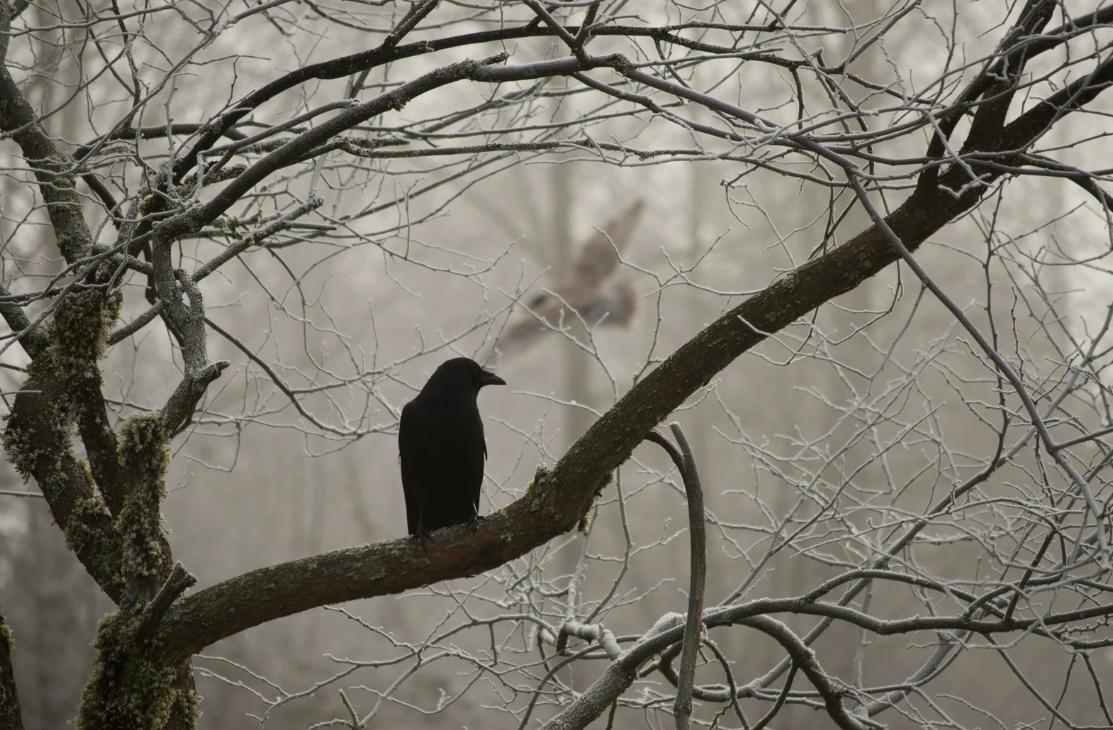
Quick answer
Crows became a bad omen in Europe for three reasons that have nothing to do with the future: they eat carrion, so they gathered on battlefields and around gallows; they are black, the colour of mourning in the Christian West; and they are loud, clever and hard to scare off. Once a bird is present at death often enough, the mind reverses the order and decides it brings death. The older version of this page tried to reassure readers by claiming the opposite, that crows protect you, warn you when you might be ill, and can be kept as pets. That is the same error with a happier face. Crows do not predict illness, death, luck or money; they eat, breed, roost and remember. The table lists seven common crow omens, where each came from, and what is actually going on. The full guide to bird sightings is Bird Sightings and What They Mean: Owls, Crows, Cardinals, Hawks, What Cultures Made of Them, Why the Bird Is There and What to Do.
Seven crow omens, their origins, and the reality
| Omen | Where it came from | Reality |
|---|---|---|
| A crow means a death is coming | Crows and ravens fed on the dead at medieval battlefields and gallows; black is the mourning colour of Europe | Death drew the crows; the bird follows carrion and does not cause or foresee anything |
| A crow on the roof means a death in the house | British and American folklore of the eighteenth and nineteenth centuries | Roofs and chimneys are high, warm lookouts; a crow on yours is watching for food |
| One for sorrow, two for joy | A British counting rhyme for magpies, first printed in the 1700s, later applied to crows | The numbers differ from county to county; it is a game, not a forecast |
| Crows are witches’ familiars | Witch trials of the sixteenth and seventeenth centuries listed cats, toads, dogs and birds as familiars | The accusation was the point; the animals were props in a prosecution |
| A murder of crows is a warning | A playful collective noun from fifteenth-century English hunting lists, alongside an exaltation of larks | A joke by medieval scribes that survived because it sounds ominous |
| A crow calling at night is bad news | Folklore in Europe and parts of Asia | Crows rarely call at night; when they do, something has disturbed the roost, usually an owl or a light |
| A crow crossing from the left is unlucky | Roman augury read the direction of a bird’s flight for the state, not for individuals | The crow is crossing to a field, a bin or its mate |
What the old version got wrong: Its claim that a crow can tell you that you might be sick is the kind of statement that keeps people from seeing a doctor, or sends them to one over a bird; symptoms are the reason to see a doctor, and confirmation bias explains why the crow you saw the week before a diagnosis feels significant. Keeping a crow as a pet is illegal in the United States without a permit. For what the bird is actually doing when it follows or scolds you, see seeing a crow.
Owls, crows, cardinals and hawks: the traditions and the birds
The hub explains what cultures made of each bird, why the bird is there, and what to do when one visits, without omens.
Can you be more specific about the content of your article? After reading it, I still have some doubts. Hope you can help me.
Crows are fascinating creatures. I appreciate the insight into their spiritual significance and the positive messages they bring.
I agree, it’s important to be open to different interpretations of animals and their symbolism.
I’ve always been intrigued by crows and ravens, but I never knew about their protective qualities. This is a fascinating revelation!
It really is! Understanding these animals’ roles in spirituality can offer valuable insights.
It’s enlightening to learn about the positive aspects of crow symbolism, especially when so many associate them with negativity.
Indeed, it’s crucial to challenge preconceived notions and approach these subjects with an open mind.
This article sheds light on the misconceptions surrounding crows and their symbolic meaning. It’s refreshing to see a positive perspective.
Absolutely, it’s important to challenge stereotypes and look deeper into the spiritual significance of animals.
The wisdom of crows is truly awe-inspiring. This article beautifully captures their symbolic importance as protectors and guides.
Absolutely, these insights can enrich our spiritual journeys in unexpected ways.
I’ve always felt a deep connection with crows. This article reaffirms my belief that they are powerful spiritual guides.
That’s wonderful to hear. It’s essential to embrace the messages nature sends us.
The connections drawn between crows and spirituality are captivating; this article provides a fresh perspective on these enigmatic birds.